
UK Buyers: Refurbished vs New, 5 Checks to Run at Checkout
For most shoppers who want maximum value, refurbished recent-model phones and laptops are worth choosing. Buy new when you need the longest warranty, an untouched battery, or the longest run of software updates. The trade-off comes down to price against certainty: refurbished saves money but asks you to check warranty terms, battery health, and returns policy before you commit. The sections below cover what “refurbished” actually means, how the factors compare, and a checklist you can use at checkout. TL;DR: Refurbished products vary widely, with manufacturer-refurbished units generally offering stronger warranties and third-party tested seller-refurbished items depending on retailer standards. Always compare refurbished prices to current sale prices, not launch prices, and verify warranty providers, battery health, and software update eligibility before purchasing. Recent-model phones and business laptops are the safest to buy

For most shoppers who want maximum value, refurbished recent-model phones and laptops are worth choosing. Buy new when you need the longest warranty, an untouched battery, or the longest run of software updates. The trade-off comes down to price against certainty: refurbished saves money but asks you to check warranty terms, battery health, and returns policy before you commit. The sections below cover what “refurbished” actually means, how the factors compare, and a checklist you can use at checkout.
ZoneofferCompare Better Deals On TechZone Offer brings electronics deals from recognised retailers together, helping you compare options and find value with less shopping time.Explore electronics dealsTL;DR:
- Refurbished products vary widely, with manufacturer-refurbished units generally offering stronger warranties and third-party tested seller-refurbished items depending on retailer standards.
- Always compare refurbished prices to current sale prices, not launch prices, and verify warranty providers, battery health, and software update eligibility before purchasing.
- Recent-model phones and business laptops are the safest to buy refurbished, while large appliances and earbuds carry higher risks due to hidden faults or hygiene issues.
- Confirm at checkout that warranty terms, battery condition, and return policies are clearly stated, and test the device immediately upon arrival, documenting its condition.
- Statutory protections under the Consumer Rights Act 2015 apply equally to refurbished goods, ensuring right to repair, replacement, or refund within specified timeframes if faults are found.
What “refurbished” actually means
The term covers a wide range of products, and sellers do not all use it the same way. Manufacturer-refurbished stock has usually been tested and repaired by the original brand or an approved partner, often with a formal warranty attached. Seller-refurbished items go through third-party testing and repair, with quality depending entirely on that seller’s standards. Open-box items are typically unused stock returned for reasons unrelated to a fault, while used items carry no refurbishment process at all, just a resale.
Grading systems (commonly labelled A, B, or C) describe cosmetic condition, but there is no shared industry standard behind these letters, so a “Grade B” phone from one seller might look better than a “Grade A” from another.
- Manufacturer-refurbished: repaired and tested by the original brand, usually with the strongest warranty.
- Seller-refurbished: quality depends on that specific retailer’s testing process.
- Open-box: unused stock, returned before it left a customer’s hands.
- Used: resold as-is, with no refurbishment step.
There is no single legal definition of “refurbished”, which means transparency from the seller, not the label itself, is what protects you as a buyer.
Refurbished vs new: comparing the factors that matter
Price is the obvious draw, but it only tells half the story. Work out real savings by comparing the refurbished price against the item’s current sale price, not its original launch price, since new-model pricing drops quickly within the first year.
Warranty length varies enormously. Manufacturer-refurbished stock often includes a one-year warranty, while marketplace sellers can offer anything from 30 days to several years. Always check who backs the warranty, the manufacturer or the retailer, since return logistics differ between the two.
Battery health is the hidden cost on any portable device. Batteries are not always replaced during refurbishment unless the listing says so explicitly, and treating any battery below roughly 80% of original capacity as a cost you’ll need to budget for is a sensible default. Software support matters just as much for laptops: confirm the device can still run current operating systems before you buy, particularly since Windows 10 standard support ended on 14 October 2025.
Cosmetic condition, meanwhile, tends to matter far less than buyers assume. A scuffed case has no bearing on how the device performs, whereas a functional defect, such as a swollen battery or a faulty port, does.
- Compare refurbished prices against current sale prices, not launch prices.
- Confirm who backs the warranty and how returns are handled.
- Ask for battery capacity or cycle count in writing before buying.
- Check software-update eligibility, especially for older laptops.
- Weight cosmetic marks lightly against genuine functional faults.
Which devices are safe to buy refurbished, and which aren’t
Not every product category carries the same risk. Some devices refurbish well because their components age predictably; others hide faults that only show up after weeks of use.
- Phones and tablets: recent-model refurbished phones tend to be a strong choice, provided the listing discloses battery health and the model is no more than two or three years old.
- Laptops: business-class refurbished laptops (built for corporate fleets, with more durable components) tend to hold up better than consumer ultrabooks, which are harder to repair and often show more wear.
- Headphones and earbuds: over-ear headphones can be a reasonable refurbished pick, but earbuds are usually a poor one, since battery degradation and hygiene concerns are harder to verify.
- TVs and large appliances: panel faults and transport damage make these higher risk on return, so buying new is usually the safer route unless the seller offers a strong warranty and returns policy.
- Accessories and streaming devices: chargers, cables, and streaming sticks are generally low-risk refurbished buys, since they have few moving parts and little to degrade.
The pattern across categories is consistent: the more a device relies on a battery or a screen, the more scrutiny the listing deserves.
How to buy refurbished safely
A short checklist at checkout catches most of the problems buyers run into later. Before paying, confirm the seller states the warranty terms explicitly, discloses battery health or cycle count, lists the exact model and specification, and sets out a clear returns window with a note on who covers postage. Genuine condition photos and a plain-language grading definition are good signs; vague, copy-paste descriptions are not.
- Warranty terms are stated in writing, not implied.
- Battery health or cycle count is disclosed, not left blank.
- The exact model and specification match what you’re paying for.
- The returns window and postage responsibility are both clear.
- Condition photos and a grading definition are provided, not just a generic label.
Red flags include vague product descriptions, no mention of battery condition, a returns window under 14 days, or a seller reachable only by an email address with no phone number or trading address listed.
Once the device arrives, test it immediately: check the battery health reading, run through calls, charging, cameras, and ports, and note any cosmetic issues against the listing photos. Report any fault as soon as you find it, since the clock on your statutory rights starts from delivery.

Pro Tip: Photograph the device and its battery health screen on the day it arrives, before you do anything else with it. That timestamp becomes your evidence if a dispute arises later.
Consumer rights and what they mean for refurbished buys

Refurbished goods carry the same statutory protections as new ones. Under the Consumer Rights Act 2015, you have a short-term right to reject faulty goods within 30 days, and a right to repair or replacement for up to six months, during which the burden of proof sits with the seller rather than you.
Buying online adds a separate layer: distance selling rules give you a 14-day cancellation period after delivery, a further 14 days to return the item, and a 14-day limit for the refund to be processed once it’s received back.
- Keep your order confirmation and any correspondence about condition or warranty.
- Report faults in writing as soon as you notice them, not weeks later.
- Know that the 30-day and six-month windows apply regardless of the “refurbished” label.
Value, sustainability, and where due diligence still matters
Bargain hunters and gift buyers can usually lean towards refurbished with confidence; mission-critical users, those who can’t afford downtime, often do better buying new. Genuine refurbishment extends a device’s working life, which is a real environmental gain, not just a marketing line. None of that replaces checking the battery and returns policy yourself: the saving only holds up if the basics are covered.
— ZoneOffer
Finding vetted refurbished deals through Zone Offer
An online platform brings together refurbished and discounted listings from partner retailers in one place, with filters for price, category, and condition so you can compare options without checking a dozen sites separately. Recent listings have included an Apple refurbished iPhone 13 in green at £230.99 and an Apple refurbished iPhone 15 Plus in black at £364.99, giving a sense of the range across model years.
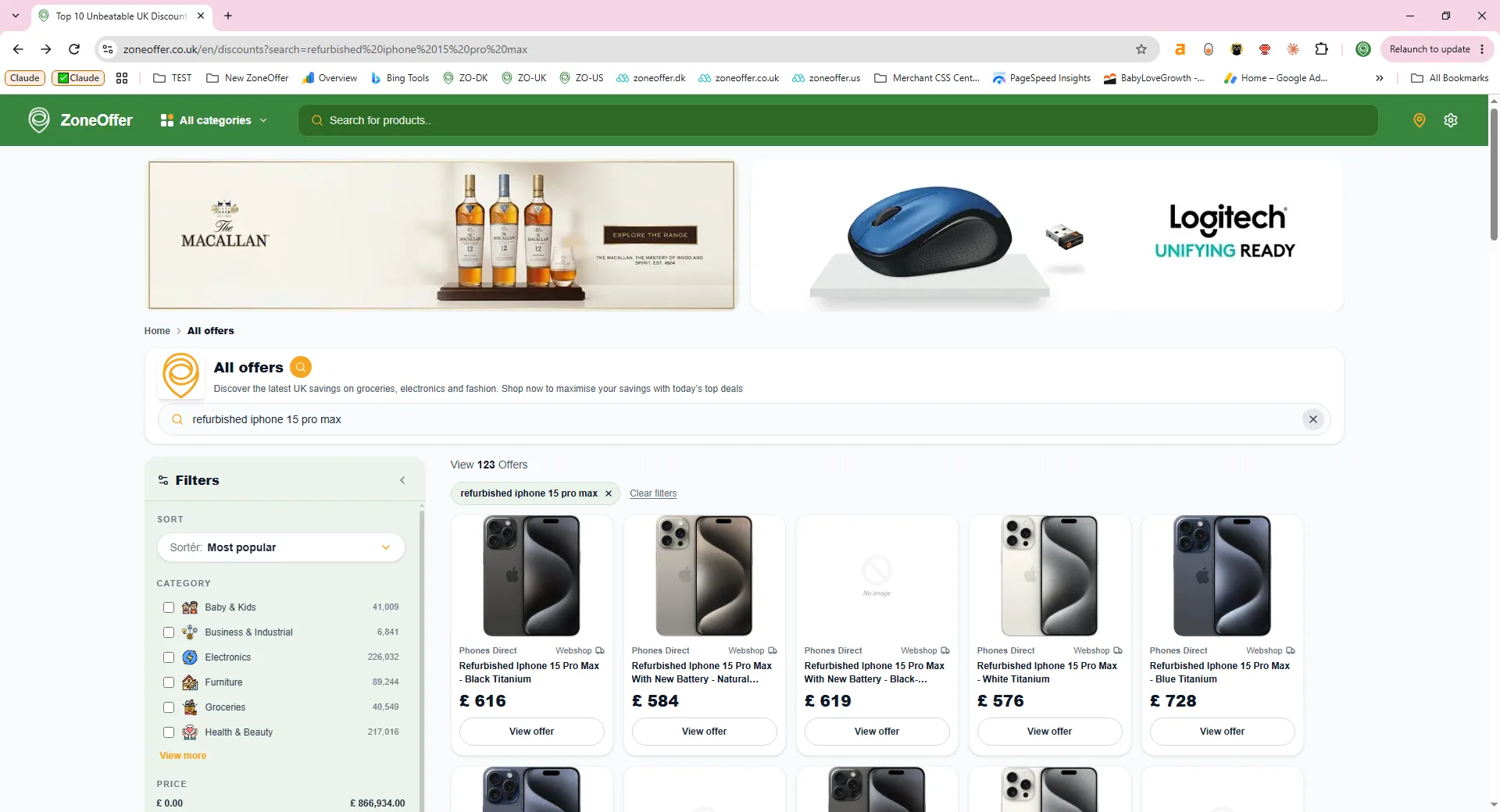
- Browse curated electronics deals, including refurbished listings, on one page.
- Compare condition, price, and retailer before you click through.
- Apply the checklist above to any listing before you buy.
Start with the electronics deals on Zone Offer to see what’s currently available.
Sources
For legal detail, see the Consumer Rights Act 2015 and GOV.UK’s returns and refunds guidance. For buying advice, The Verge and WIRED both cover the practical checks in more depth.
FAQ
Is it better to get refurbished or new?
Refurbished tends to suit buyers who want lower cost and are comfortable checking warranty and battery details first, while new suits anyone who needs the longest support window or can’t tolerate any downtime. The right choice depends more on the device category and your tolerance for checking the details than on price alone.
What is the disadvantage of refurbished?
The main disadvantages are inconsistent grading standards between sellers and the risk of undisclosed battery wear, since there’s no single legal definition of “refurbished” governing how the term is used. Warranty length and cover can also be shorter or less reliable than on a new product.
Is it risky to buy refurbished?
It carries more risk than buying new, but the risk is manageable if you check warranty terms, battery health, and the returns policy before purchasing. Refurbished goods bought in the UK still carry the same statutory protections as new items under the Consumer Rights Act 2015.
Is it a good idea to buy refurbished products?
For most phones, tablets, and business laptops, refurbished is a sound way to get better hardware for less, provided the seller discloses battery condition and offers a clear warranty. It’s a weaker choice for TVs, large appliances, and earbuds, where functional faults are harder to catch before you buy.
Keep exploring
Related guides

Stop Scams Fast: UK Online Shopping Safety with Section 75
Verify the seller, pay with a protected method such as a credit card, and turn on two-step verification wherever it is offered.
Published 30 September 2026

Save 17 to 25%: supermarket price comparison for UK weekly shops
The fastest way to find genuine savings is to build a real basket, check unit prices item by item, and factor in loyalty discounts using a price comparison tool or a manual check.
Published 29 September 2026

Unit price checks beat UK supermarket price match; try ZoneOffer
Yes, but the landscape has narrowed. Tesco, Sainsbury’s and Morrisons run active price-match schemes, mostly benchmarked against Aldi, while Asda scrapped its version entirely in January 2025.
Published 28 September 2026