

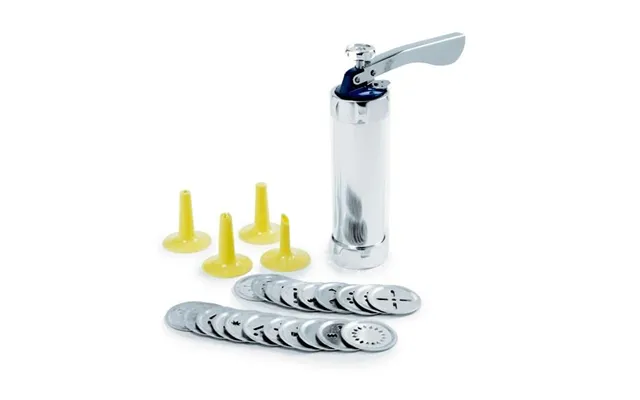
Cookie Presses price list
Last updated Monday, 19 Oct 2026
| Cookie Presses | Price |
|---|---|
| Cookie Icing Press Gun | £18.05 |





View 1 Offers
Loading...
Last updated Monday, 19 Oct 2026
| Cookie Presses | Price |
|---|---|
| Cookie Icing Press Gun | £18.05 |
If you love the look of fancy, uniform cookies without hours of piping or rolling, a cookie press is like a magic wand for your kitchen. It lets you squeeze out perfectly shaped cookies in seconds — think rosettes, stars, and hearts all the same size, as if you had a tiny cookie factory on your countertop. Whether you’re decorating for the holidays, making batches for a bake sale, or just want even, consistent cookies every time, a cookie press speeds things up and makes baking fun.
At its simplest, a cookie press is a tube or barrel that holds dough and forces it through patterned disks or nozzles as you press or trigger a plunger. Manual presses use a lever or trigger to push dough out; electric presses use motorized action. The shaped dough drops directly onto a baking sheet, so you can churn out dozens of cookies in minutes. Think of it as a toothpaste tube for cookie dough — the pattern on the end determines the shape.
Manual cookie presses are the classic option. They’re usually lighter, simpler to clean, and don’t need a power outlet. You load the barrel with dough, select a disk, and squeeze or turn a plunger. Manual presses give you good tactile control over the dough output, which some bakers prefer when working with slightly stiffer doughs. They’re also great if you bake on the go or in kitchens with limited plug sockets.
Electric cookie presses remove most of the elbow grease. They’re ideal for larger batches since the motor consistently pushes dough out with each press, which can be huge during holiday baking marathons. Many electric models include speed settings and come with dozens of disk shapes. If you bake several dozen cookies at once, an electric press is like hiring an extra pair of hands.
Cookie presses come in plastic, metal, or a mix of both. Stainless steel or heavy-gauge aluminum will last longer and feel sturdier in your hand, while BPA-free plastics keep costs low and reduce weight. Look for a solid feel — a flimsy barrel or wobbling handle makes your baking session less pleasant. If you want a press that will be in your kitchen for years, prioritize metal construction on the barrel and plunger mechanism.
The number and style of disks or nozzles determine how many shapes you can make. Basic sets have a handful of shapes like stars, flowers, and Christmas trees. More deluxe models offer 20 to 30 disks and specialty shapes for occasions. If you like variety or entertain seasonal themes, pick a set with many disks or buy extra disk packs that fit your press.
Barrel capacity matters when you’re making large batches. Most home cookie presses hold between 4 and 8 ounces of dough — enough for dozens of cookies before needing a refill. A wider barrel makes filling easier and reduces the time you spend reloading. Some designs allow cartridge-style refills which can speed up batch work and make cleanup neater.
Baking means dough, and dough means cleanup. Look for presses with removable parts that can be rinsed quickly or tossed in the dishwasher. Stainless components and simple shapes make washing easier than complicated internal gears. If you dread cleanup, prioritize dishwasher-safe pieces and avoid presses with too many tiny crevices where dough can hide.
There are dozens of cookie presses on the market, but a few types consistently earn good reviews: sturdy stainless-steel manual presses for durability, electric presses for volume, and budget plastic presses for casual bakers. Popular brands in the category include Wilton, OXO, and Nordic Ware, each offering models that suit beginners through experts. Below are bite-sized summaries to help you decide which style fits your baking habits.
A metal manual cookie press is ideal if you want a tool that feels professional and lasts. These presses often have a solid metal barrel and a comfortable handle. They excel with standard sugar or butter cookie doughs and don’t require power, so they’re dependable for every holiday. If you prefer tactile control and a classic feel, a metal manual press pays off over time.
If you’re baking a lot — think holiday parties, fundraisers, or gift boxes — an electric press minimizes fatigue and keeps shapes consistent. Electric models often include dozens of discs, variable speed settings, and large barrels. The convenience and speed make them worth the counter space, especially when dozens of identical cookies are on the to-do list.
For occasional bakers, a plastic press with a handful of disks is a great starting point. These are lightweight, usually include some handy extras like decorative tips, and are easy to store. They’re not as durable as metal models, but for the occasional cookie press session, they provide excellent value and fun designs.
The right dough makes or breaks your cookie press experience. Pressed cookies typically need a softer, squeezable dough that holds shape but isn’t too sticky. A common measuring cup recipe uses about 2 cups of flour, 1 cup of butter (or 8 ounces), 3/4 cup of sugar, one large egg, and flavorings. Chill the dough briefly if it’s too sticky — about 10 to 15 minutes in the refrigerator often helps. The ideal dough should be like soft cookie dough for drop cookies: pliable and smooth.
Here’s a quick mental checklist: the dough should glide when pushed by a spoon, not slump on its own. It should hold the pattern when piped onto a sheet and spread very little in the oven. If your cookies spread too much, try reducing the butter slightly or chilling the dough for 10 minutes before pressing.
Baking pressed cookies is straightforward, but a few tricks help you get picture-perfect results. Preheat your oven to between 325°F and 375°F, with many recipes landing around 350°F. Use an ungreased cookie sheet or a sheet lined with a silicone baking mat so the cookies can grip slightly and maintain their shape. Keep cookies about 1 to 2 inches apart depending on the shape — smaller shapes can be closer together. Bake times vary with size and thickness but often fall between 8 and 12 minutes; watch for just-turned-golden edges.
Smaller shapes like stars or dots often end up about 1 inch across, while rosettes and larger shapes can be 1.5 to 2 inches. If you want uniformity, squeeze evenly and aim for the same press pressure each time. A consistent hand gives you a tray of cookies that look like they were made by a machine — because, in a way, they were.
After the last tray is out of the oven, clean your press promptly. Dried dough becomes much harder to remove. Disassemble the press according to the manufacturer’s instructions and rinse parts under warm water. If your press isn’t dishwasher-safe, soak stubborn bits in warm, soapy water for a few minutes before scrubbing gently with a brush. Dry thoroughly to prevent any metal parts from spotting or plastic parts from trapping moisture.
Store your press in a dry place, ideally in its original box or a dedicated container so disks and small parts don’t disappear. If the press has moving parts or a small metal spring, a tiny dab of food-safe oil once per season can keep the mechanism smooth. Label disk packs in a small zip bag so you can find seasonal shapes quickly.
Cookie presses pair perfectly with a small suite of accessories that make baking easier and more enjoyable. A few well-chosen items will elevate your pressed cookies from good to stunning without breaking the bank.
Start with a silicone baking mat or parchment paper to make removal easy and cleanup minimal. A set of cooling racks prevents soggy bottoms and helps cookies set quickly. A bench scraper or offset spatula helps lift delicate shapes from the sheet without deforming them. Finally, cookie dough scoops and a mini bench scraper make handling dough quick and mess-free.
If you decorate, consider small piping bags and tips for adding icing or sprinkles after baking. A small set of edible color gels lets you tint dough subtly for pastel holiday cookies. For gifting, compact cookie tins and cellophane bags present your pressed cookies like bakery treats.
Shopping smart means comparing specs as well as prices. Look at material, number of disks, capacity, and warranty when comparing models. Comparison sites can help you see multiple offers at once and surface seasonal sales or bundle deals that include extra disks or accessories. Read recent user reviews to catch patterns: a restaurant-quality feel, long-lasting mechanism, or consistent motor performance often shows up in multiple testimonials.
Major sales seasons like late fall and winter typically bring the best prices for baking gear. If you’re not in a hurry, watch comparison sites and sign up for price alerts to pounce when popular models drop in price. Buying a set with extra disks or accessories can sometimes be cheaper than buying extras later.
Cookie presses are an accessible, fun way to create consistently shaped, attractive cookies with minimal fuss. Whether you go for a sturdy stainless-steel manual press, a fast electric press for big batches, or a budget-friendly plastic kit for occasional projects, the right press plus the right dough sets you up for baking success. Pair it with simple accessories like a silicone mat and cooling rack, follow the dough consistency and baking tips above, and you’ll be turning out trays of bakery-worthy cookies in no time. If you want to compare models and prices quickly, a comparison site can help you find the best deal that fits your budget and needs without hours of searching.