

Clock Parts price list
Last updated Sunday, 18 Oct 2026




View 6 Offers



Loading...
Last updated Sunday, 18 Oct 2026
When a clock stops, your day seems to skip a beat—because clocks are more than timekeepers. They’re style pieces, conversation starters, and quiet heroes in the background of your home. Swapping a tired movement, choosing a fresh set of hands, or picking a dial that suits your decor can transform a room for a fraction of the cost of a new clock. And with popular offers and price lists easy to compare in the UK, it’s never been simpler to find quality clock parts that match your budget and your taste. Ready to tune up your timepiece and refresh your space?
Think of the movement as the heart of your clock. It’s the hidden mechanism that drives the hands, keeps time, and, in some cases, powers a pendulum or chimes. Most DIY-friendly clocks today use battery-powered quartz movements, but there’s a whole world of options—silent sweep, high-torque for large hands, pendulum-ready, and chiming modules. Understanding what each one does helps you pick the right part the first time, and that means better reliability, better value, and a smoother install.
Quartz movements are the clear winner for most home projects. They’re affordable, accurate, and easy to install—usually powered by a single AA battery. If you want fuss-free reliability, quartz is your friend. Mechanical movements, on the other hand, are works of art: springs, gears, and escapements that need winding and maintenance. They’re perfect for restorations or heirloom pieces like mantel and longcase clocks. For everyday wall clocks, a quartz movement with the right shaft length and torque is the practical pick. For a vintage vibe and authentic craftsmanship, mechanical is a passion project worth the effort.
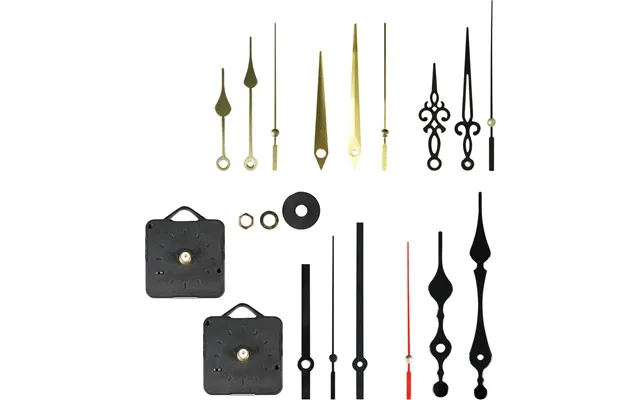
Hands and dials set the tone of your clock’s personality. Sleek black baton hands make a minimalist statement; ornate spade hands lean classic; broad, high-contrast hands are ideal for reading across a room. Dials do the heavy lifting for legibility—choose clear numerals, bold markers, or open skeleton designs for a modern edge. Matching the style of the hands and dial to your decor turns a basic movement upgrade into a decor refresh that looks curated, not cobbled together.
Here’s the measuring trick you’ll use again and again. Hand length is measured from the center mounting hole to the tip: a 5 in minute hand works well for dials around 10 to 12 in across; a 12 in minute hand suits big statement clocks up to 24 in diameter. Next, check the movement’s shaft length. You want the threaded shaft to be just long enough to clear your dial and any bezel—common threaded lengths are about 5/16 in, 3/8 in, and 1/2 in. If your dial is 1/4 in thick, a movement with a 5/16 in threaded shaft usually fits beautifully, leaving enough thread to secure the nut without excess wobble.
Pendulums and chimes bring texture and tradition to a clock. The soothing swing of a pendulum can anchor a room, while Westminster-style chimes add charm to entries and living spaces. Many contemporary quartz modules support a decorative pendulum without complexity. If you’re after chimes, pick a movement with adjustable volume and night-silence. The beauty here? You get the classic look and sound, powered by easy batteries and modern reliability—no weekly winding required.
If your minute hand is longer than 6 in—or if you’re building a large wall clock with 18 to 24 in hands—standard movements often struggle. That’s where high-torque movements shine. Built to handle larger, heavier hands, they maintain accuracy without stalling. Make sure your long hands are lightweight aluminum and balanced. Some suppliers rate movements by maximum hand length; aim for a unit designed for at least 12 to 18 in hands if your design is oversized. It’s the difference between a clock that looks impressive and one that actually keeps time.
DIY clock kits are brilliant if you want a no-guesswork build. Most include a quartz movement, a selection of hands, mounting hardware, and sometimes a simple dial—ideal for first-time projects or gifts. Repair kits, on the other hand, target common fixes: replacement movements, assorted hands, second caps, washers, and mounting nuts. Whether you’re reviving a beloved wall clock or assembling a clean, modern design, kits simplify your shopping and help you match parts that belong together.
You don’t need a full workshop to service a clock. A small Phillips screwdriver, a flat screwdriver, needle-nose pliers, a soft cloth, painter’s tape, and a drill with a 3/8 in to 1/2 in bit for the center hole will cover most jobs. A ruler or tape measure marked in inches is essential for measuring hand length and dial thickness. If you’re working on a vintage case, a gentle wood polish and a can of compressed air go a long way. Keep a couple of fresh AA batteries on hand for testing—nothing stalls a build like a weak battery.
Installing a quartz movement is easier than it looks. Remove the old hands by gently wiggling them straight up. Note the order of any washers and nuts. Slide the new movement’s shaft through the dial from the back, add the rubber or fiber washer, then the brass washer, and secure the hex nut hand-tight. Fit the hour hand first (press-fit), then the minute hand (often secured with a small nut), and finally the second hand if your model includes one. Align them at 12 o’clock, pop in a battery, and test for smooth rotation without rubbing or stalling. Simple, tidy, satisfying.
Three hiccups trip people up. First, using a shaft that’s too short for the dial—if the threaded section can’t fully clear the dial, the hands will bind. Second, bending the hands during install; even a slight warp can cause them to touch and stop the movement. Third, mixing hand types with the wrong movement—press-fit hands won’t sit properly on a screw-mount arbor, and vice versa. If you’re unsure, check the movement type (press-fit vs. threaded minute hand) and order matching hands from the start.
Hands colliding at around 6 or 12? Gently lift the minute hand a hair to clear the hour hand. Losing or gaining time? Swap to a fresh AA battery and verify that the hands aren’t rubbing the dial or each other—drag creates tiny stalls. Ticking noise too loud? Consider a silent sweep movement (also called continuous sweep); it glides smoothly instead of stepping each second. If the clock stops at the same time every hour, the hands are likely catching; inspect at eye level and adjust clearance.
Silent sweep movements ditch the tick-tick and move the second hand in a smooth circle—great for bedrooms, offices, and studios. But “silent” doesn’t mean “fault-proof.” Poor alignment can make any movement buzz against the case. Mount the movement snugly (not over-tightened), use the foam or rubber washer, and ensure the case doesn’t flex. If you still hear a faint hum, add a thin felt pad between the case and the wall to damp vibrations. You’ll be amazed how much quieter a well-mounted clock sounds.
With so many options, smart shopping comes down to specs, compatibility, and a little patience. Scan multiple retailers and comparison platforms to spot the best price on like-for-like parts. Note the movement model, shaft length, torque rating, hand mounting type, and what’s actually included (washers, nuts, second hand, and hardware). Bundles can save money if you need several parts at once. For premium pieces like chiming modules and mechanical components, compare warranties and support as part of the total value—not just the sticker price.
Specs are your buying compass. For movements, look for the threaded shaft length in inches, the recommended maximum hand length, and whether it’s press-fit or screw-mount. For hands, confirm total length from center hole to tip and the mounting hole shape (round, oblong, or square). Reviews reveal real-world quirks: whether hands are lightweight enough for reliable running, if the movement is truly quiet, and how easy installation feels for beginners. If you’re building a large feature clock—say, a 24 in wall piece—reviews mentioning high-torque performance are pure gold.
Clock decor trends span clean, modern lines to nostalgic, ornate designs. Minimalist enthusiasts love monochrome dials, slim baton hands, and no numerals—just crisp markers. Industrial and steampunk looks pair skeleton dials with bold Roman numerals and brushed metal hands. Vintage flavor leans toward cream dials, serif numerals, and spade or Breguet-style hands. Want a trend-proof look? Matte black hands on a white dial with clear numerals are as readable as a road sign and never go out of style.
Modern builds favor silent sweep movements, slim bezels, and oversized dials—think 18 to 24 in showpieces. Vintage projects often involve restoring wooden cases, polishing brass bezels, and selecting delicate hands that suit smaller dials around 8 to 12 in. If you’re mixing old and new, try a quartz movement inside a vintage case. You’ll keep the charm while gaining accuracy and convenience. It’s like giving a classic car a reliable new engine—best of both worlds.
Pendulum-ready quartz movements let you hang a decorative pendulum bob that sways serenely while the clock keeps quartz-accurate time. Most pendulum assemblies are adjustable for length, typically ranging from about 8 in to 16 in so you can match proportions to your case. For outdoor clocks, choose weather-resistant dials, UV-stable hands, and a sealed case. Large outdoor designs often use high-torque movements to drive 14 to 18 in hands that stay visible across the patio or garden.
For durability, aluminum hands resist warping and keep weight down—crucial for accuracy. Steel can look great but adds weight; pair it with high-torque movements. Acrylic or polycarbonate dials handle moisture better than paper-on-board dials, especially in kitchens and porches. If you love the look of aged brass, consider lacquered finishes to avoid constant polishing. A little planning on materials saves hours of upkeep later.
Turning a flea-market find into a fresh clock is both budget-friendly and eco-conscious. Salvage a beautiful frame or wooden case, add a new quartz movement, and choose hands that complement the patina. A clear-coated, sanded plank with a 3/8 in center hole can become a rustic dial in an afternoon. Keep old movements and parts in a labeled box; spare washers, nuts, and hand caps often rescue future projects. With comparison sites and UK deals, you can source parts affordably and keep usable materials out of the bin.
Use quality alkaline AA batteries for consistent performance. Replace them yearly (or at the first sign of drifting time). If a clock is hard to access, write the install date on a bit of tape inside the case. For chiming movements, some units use two AAs—one for timekeeping, one for the chime. Clean dust with a soft cloth and a puff of air; never spray cleaner directly into the movement. Small habits keep your clock accurate and your decor looking sharp.
Chiming quartz movements bring in melodies like Westminster, Whittington, and Ave Maria, often with a night-silence switch so evenings stay peaceful. Multi-function dials with separate second subdials or date windows add interest without clutter. If you love tech, pair your traditional dial with a radio-controlled quartz movement for automatic time updates after battery changes. You’ll enjoy precision without losing the warmth of analog decor.
Building a statement clock for a large wall? Start with the dial size—18 to 24 in looks stunning over a sofa or mantel. Choose a high-torque movement rated for your hand length, and pick lightweight hands around 14 to 18 in for balance and visibility. Mount the clock securely with wall anchors appropriate for your surface. Mock up the layout with painter’s tape before drilling; it’s easier to adjust positioning on tape than patch holes later. Measure twice, drill once, enjoy for years.
When browsing UK deals on clock parts, clarity is everything. Great offers list the movement model, torque rating, shaft measurements in inches, hand compatibility, and all included hardware. Watch for bundles that pair a movement with multiple hand styles—handy if you’re undecided on the final look. Price lists that separate standard quartz, silent sweep, high-torque, pendulum, and chiming movements make comparison much easier. The goal isn’t just the lowest price—it’s the right part, good warranty coverage, and styles that suit your space.
Before you buy, confirm four things: dial thickness, center hole size (3/8 in to 1/2 in is common for DIY dials), hand mounting type, and the maximum minute hand length your movement supports. If you’re upgrading a pre-built clock, measure the existing shaft from the case front to the tip of the threaded section, then match it. Take a photo of your current hands and movement so you can cross-check mounts and shapes. Five minutes of measuring saves an afternoon of frustration.
Refreshing a clock is one of the quickest, most rewarding home projects you can tackle. Choose a movement that suits your design (silent, high-torque, pendulum, or chime), match hands and a dial that fit your style, and double-check measurements in inches for a clean install. With smart comparison of UK offers and clear specs in hand, you’ll get quality parts at great value—no guesswork, no drama. The result? A timepiece that keeps perfect time, looks fantastic, and ties your room together like it was meant to be there all along.