

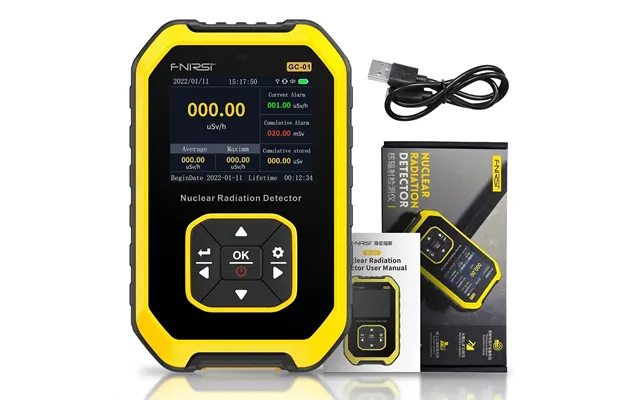
Geiger Counters price list
Last updated Monday, 19 Oct 2026
| Geiger Counters | Price |
|---|---|
| Fnirsi Gc-01 Geiger Counter Nuclear Radiation Detector | £39.99 |



Loading...
Last updated Monday, 19 Oct 2026
| Geiger Counters | Price |
|---|---|
| Fnirsi Gc-01 Geiger Counter Nuclear Radiation Detector | £39.99 |
Wondering whether you really need a Geiger counter? If you work with radioactive materials, live near an old industrial site, collect vintage items like luminous watches, or simply want peace of mind about background radiation in your home, a compact radiation detector can be a great investment. These handheld devices let you quickly spot elevated counts and take sensible action, whether that’s moving away from a hotspot or checking an unfamiliar object. Think of a Geiger counter as a smoke alarm for radiation — small, portable, and built to alert you when something’s out of the ordinary.
At its core, a Geiger counter senses ionizing radiation by counting the tiny electrical pulses created when radiation interacts with a gas-filled tube. Every pulse registers as a “click” or a numeric increase called counts per minute (CPM). Most devices translate those counts into dose rate units like millirem per hour (mrem/hr) so you can compare readings to familiar safety thresholds. The basic idea is straightforward: higher CPM or higher mrem/hr equals more radiation. That said, the conversion depends on the detector type and calibration, so use readings as a guide, not a perfect measurement.
There’s no one-size-fits-all detector. Different technologies suit different tasks, from quick spot checks to professional surveys. Knowing the main types helps you pick the right tool for the job.
G-M tube detectors are the classic handheld units most people picture as “Geiger counters.” They’re rugged, affordable, and respond to beta and gamma radiation well. They’re great for hobbyists, home checks, and basic safety uses. Expect good sensitivity but limited ability to distinguish radiation energy levels, which means they’re best for detecting presence and relative intensity rather than detailed analysis.
Scintillation detectors use crystal materials that glow when struck by radiation, producing a pulse that’s counted and often analyzed for energy. These units are more sensitive and can differentiate between types and energies of radiation, making them excellent for more precise surveys and professional work. They tend to be larger and pricier, but if you need to detect weak sources or low-dose environments, a scintillation meter is a strong choice.
Personal dosimeters are compact, wearable devices designed to track cumulative exposure over time, usually reporting in millirem (mrem). They’re a must for workers who may be exposed regularly and prefer a small badge or pocket meter that logs dose. Many modern dosimeters also offer alarms for preset dose thresholds and data download capability for record keeping.
There’s a wide range of products on the market, from basic pocket meters to advanced survey instruments. Below are common models and categories people look at, along with what they’re best suited for. If you want to shop smart, compare specs like CPM range, dose rate in mrem/hr, detector type, and battery life.
Budget pocket meters are compact, lightweight tools ideal for quick checks on antiques, soil, or luggage. Typical units weigh under 8 ounces and measure a few inches across, with battery life often around 100 hours. They’ll show CPM and sometimes mrem/hr, excellent for casual use and travel. Just remember these models can struggle with very low-dose detection and won’t replace a professional survey meter.
Mid-range models provide better sensitivity, a wider CPM range, and clearer displays. Many include data logging, adjustable alarms, and USB connectivity so you can export readings. They’re usually powered by rechargeable batteries lasting up to 20–30 hours and weigh roughly 0.8–1.2 pounds. These are the go-to choice for serious hobbyists, mineral collectors, and homeowners wanting reliable measurements without professional-level cost.
For professionals or anyone who needs precise results, survey meters and scintillation units deliver the sensitivity and energy discrimination required. Expect rugged housings, calibration certificates, and more comprehensive reporting. These instruments are often heavier — 1.5 to 3 pounds — and cost significantly more, but they’re essential where regulatory compliance or detailed analysis is required.
Shopping for a detector can feel overwhelming. Focus on a few core features to match the tool to your needs: sensitivity and range, detector type, display and logging, build quality, and ease of use. Below I’ll break these down so you can decide with confidence.
Sensitivity determines how well a detector sees low-level radiation. Look for higher CPM sensitivity and a dose-rate display that spans from background levels (often around 5–30 CPM depending on location) up into dangerous ranges. Good consumer meters typically show readings from single-digit CPM up to thousands of CPM and convert to mrem/hr for practical comparison.
If you need to identify low-level sources or separate alpha from beta and gamma, a scintillation detector or a multi-detector system is preferable. Single G-M tubes are fine for general surveys and detecting hotspots, but they won’t tell you much about energy or isotope type. Choose the technology based on whether sensitivity or discrimination is your priority.
Data logging is a huge convenience if you want to track exposure over time or analyze multiple readings. Many modern detectors offer USB or Bluetooth connectivity so you can view charts on a PC or phone. If you plan to document results or submit data for professional review, pick a model with reliable logging and export options.
Think about where and how you’ll use your detector. Pocket meters weigh a few ounces and slide into a bag; survey meters can be bulkier and better suited to car or site use. Check battery specs — many units run 8–20 hours on replaceable batteries, while rechargeable models can exceed 24 hours on a single charge. Durability matters too if you work outdoors or on-site.
Getting useful readings requires a little technique. Hold the detector steady and close to the surface you’re testing, keep it away from your body and electronics, and allow readings time to stabilize. Walk slowly for area surveys to spot peaks, and use spot checks for specific objects. If you encounter a high reading, back off a few feet and re-check; radiation intensity drops quickly with distance.
Interpreting detector output is easier when you know common thresholds. Typical background levels might read a few to a few dozen CPM, depending on your location. As a rough guide, sustained readings above 100–200 CPM or several mrem/hr warrant attention and further investigation, while emergency levels are much higher and require immediate action. If in doubt, consult a professional for interpretation, especially for occupational or legal concerns.
People use detectors for many reasons: checking antiques and watch dials, testing soil and building materials, screening incoming mail or packages for contamination, monitoring background levels after an incident, and for hobbyist mineral or meteorite hunting. Small dosimeters keep track of cumulative exposure for workers, while survey meters are used in labs, hospitals, and industrial sites for routine safety checks.
Your choice boils down to purpose. If you just want occasional peace-of-mind checks or to scan collectibles, a budget or mid-range handheld is usually enough. If you need trace-level sensitivity, energy discrimination, calibration certificates, or regulatory compliance, you’ll want a professional-grade unit. There’s no shame in starting simple and upgrading as your requirements grow.
Consider adding a few accessories to get the most from your detector: a sturdy carry case, a calibration source (for professionals and trained users), external probes for alpha detection, and spare batteries or a portable charger. A simple tripod or clamp can help with long-term measurements, and protective gloves are smart when checking suspect objects.
When you’re ready to buy, comparison sites and specialist retailers are helpful for comparing specs and deals. Look for sources that list CPM ranges, mrem/hr conversion, detector type, and include customer reviews. Comparison platforms make it easy to scan prices across sellers, check warranty and calibration options, and identify the best value for your needs.
Choosing the right Geiger counter means matching features to real-world needs: do you want portability, sensitivity, professional reporting, or the lowest price? Start with your main use case, pick a detector type that matches, and prioritize clear specifications like CPM range, dose-rate readout in mrem/hr, and data logging. With the right device in hand, you’ll gain confidence and practical protection when assessing radiation risks in everyday life.
Radiation detectors, from simple pocket Geiger counters to advanced scintillation meters, offer peace of mind and real safety benefits when used correctly. Whether you’re a curious homeowner, a hobbyist collector, or a professional needing documented readings, there’s a model that fits your needs and budget. Focus on the detector type, sensitivity, and practical features like data logging and battery life, and don’t hesitate to use comparison tools to find the best deal. With a little knowledge and the right gear, you’ll be able to spot hotspots, measure exposure in mrem/hr, and make informed decisions quickly and confidently.