

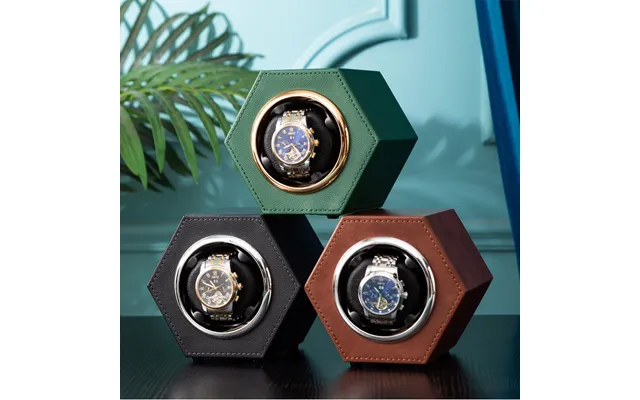
Watch Winders price list
Last updated Monday, 19 Oct 2026
| Watch Winders | Price |
|---|---|
| New Hexagonal Single Head Mini Single Watch Box Motor Box Two-speed Adjustable Watch Shaker | £28.89 |





Loading...
Last updated Monday, 19 Oct 2026
| Watch Winders | Price |
|---|---|
| New Hexagonal Single Head Mini Single Watch Box Motor Box Two-speed Adjustable Watch Shaker | £28.89 |
If you own an automatic watch, you know the small frustration of coming back to a stopped timepiece after a few days in rotation. Watch winders are the unsung heroes that keep your watches ticking, ready to wear at a moment’s notice. In this guide I’ll walk you through everything from choosing the right winder and understanding key features, to useful accessories that protect and enhance your collection. Think of this as a toolbox for keeping your watches happy — and your mornings simpler.
At its simplest, a watch winder is a device that rotates an automatic (self-winding) watch to simulate the natural motion of a wrist. This keeps the mainspring wound so your watch stays accurate and gutter-free of date or calendar hassles. Do you need one? If you rotate among multiple watches, own complicated pieces with perpetual calendars or moon phases, or simply like the convenience of a watch always ready to wear, a winder is a smart investment.
Automatic watches wind themselves using a small weighted rotor that swings as your wrist moves. If you don’t wear the watch for a day or more, that rotor stops and the power reserve runs down. Imagine your watch is a small engine that needs fuel to run — the winder keeps that “fuel” topped up. For watches with complex settings like annual calendars, stopping and manually resetting can be fiddly, so a winder saves time and reduces wear from frequent adjustments.
Watch winders are rated by TPD — turns per day — which tells you how much rotation your watch will receive. Different movements have different winding requirements; many need between 600 and 1,200 turns per day, but some modern movements might call for fewer. Quality winders let you choose direction (clockwise, counter-clockwise, or bi-directional) and adjust TPD, so you match the needs of each movement precisely. Think of it like tuning the watering schedule for a garden: the right amount keeps things healthy, too much or too little can be a problem.
There’s a winder for almost every collector, from single units for daily wearers to multi-watch cabinets that look like jewelry boxes. Here’s a quick breakdown so you can pick the right style for your routine.
Single and double winders are compact, affordable, and perfect if you own one or two automatics. They’re ideal for nightstands and travel, often powered by batteries or a mains adapter. If you’re after convenience without a big footprint, these are the workhorses to consider.
If your box holds several automatics, multi-watch winders (4, 8, 12, or more slots) keep everything organized and running. These often feature quieter motors, higher-grade finishes, and multiple programs so you can cater to many movements at once. They’re like a small garage for your watches — neat, efficient, and satisfying to open.
Smart winders take precision to the next level with programmable cycles, remote controls, and even app integration. Want to schedule winding only during certain hours or monitor battery life remotely? These models add convenience at a premium price, and they’re a great fit if you enjoy tech-savvy solutions.
Some winders double as display cases, with high-end materials like hardwood, carbon fiber, and glass. They’re statement pieces that protect and showcase your collection. If your watch case is part of your home décor, these winders are the equivalent of a gallery frame — they elevate the presentation.
Choosing the right winder is about matching features to your watches and lifestyle. Here are the must-check items so you don’t get stuck with a noisy or incompatible unit.
A low-noise motor is essential if the winder lives in your bedroom or office. Brushless motors and high-quality gearing reduce noise and vibration. Test or check reviews for decibel levels — you want a hum, not a clunk.
Flexibility matters. Reliable winders let you set TPD and choose rotation direction so you can configure each slot for different movements.
Battery power adds portability, while AC adapters are reliable for everyday use. If you travel often, a battery-powered winder is handy; if you keep the winder at home, mains power avoids frequent battery replacements.
Look for cushions that fit a wide range of watch sizes and strap types. Adjustable cushions or removable adapters keep odd-sized watches secure and centered, preventing stress on the strap or spring bars.
Leather, wood veneer, or carbon fiber finishes affect both looks and durability. If security is a concern, some cabinets offer lockable lids or reinforced glass for peace of mind. Consider ventilation too — sealed units can trap humidity, so breathable materials help preserve leather straps and watch oils.
There are many reputable brands in the winder world. A few names consistently come up for quality, reliability, and design. If you want a quick shortlist to research further, start here and compare features and prices to match your needs.
Look into Wolf, Orbita, Swiss Kubik, Buben & Zorweg, Heiden, JQUEEN, and Versa. Wolf and Orbita are often praised for durable motors and programs, Swiss Kubik for compact, reliable units, while Buben & Zorweg cater to the ultra-luxury market with impressive finishes and security features. Affordable but competent options from brands like JQUEEN and Versa deliver good performance for the budget-conscious buyer.
Compare TPD ranges, noise specs, power options, and warranty. Read user reviews for long-term reliability and look for return-friendly retailers or comparison sites to find current deals before buying.
On a budget, prioritize quiet motors and adjustable cushions; you can sacrifice fancy finishes and smart features. For luxury purchases, consider precision programming, premium materials, and integrated security. Spend more if you value longevity, aesthetics, and features like app control. Save if you mainly need a practical unit to keep a couple of automatics running.
Winders aren’t the only option. If your watches have long power reserves or you wear them daily in rotation, you might skip a winder. Other accessories also help protect and organize your collection.
Boxes and roll cases protect watches from dust and damage and are perfect for storage or travel. Choose padded compartments and breathable linings to protect leather straps. Boxes don’t keep watches running but are essential for safe storage and easy transport.
For frequent travelers, a compact roll or a hard-shell case keeps your watches safe during transit. Hard cases with foam inserts are excellent for flight travel, while soft rolls work for lighter protection and packing efficiency.
Basic tools — spring bar tools, strap changing kits, and microfiber cloths — let you manage straps and basic maintenance at home. A small toolkit saves trips to the shop for minor adjustments and keeps your pieces looking sharp.
Match the winder to the size and variety of your watches. If you have oversized divers or vintage pieces, check cushion diameter and slot size in inches to ensure a snug fit. For mixed movements, pick a multi-zone winder or multiple single units so each movement gets the correct TPD and direction. Also think about where you’ll place it — a tabletop unit should be compact and quiet, while a showpiece cabinet can be larger and louder if kept in a study or closet.
Setting up is usually straightforward: install the cushion, place the watch securely, set the program, and plug it in or insert batteries. For maintenance, keep the unit clean, dust-free, and away from direct sunlight and extreme humidity. Lubrication of internal gears typically isn’t a user task; if your winder shows signs of wear or gets noisy, contact the manufacturer or a qualified repair service. Treat the winder like an appliance — a little care extends its life significantly.
Deals appear often, especially around seasonal sales and holidays. Use comparison sites to see current price lists and offers from multiple sellers — they can highlight discounts and warranty differences quickly. Read return policies and warranty details before buying, and check real-user reviews for long-term performance notes. If you’re in the UK or elsewhere, look for sellers that list clear delivery and warranty terms so you know what support you’ll have if anything goes wrong.
Think long term: a well-made winder can last many years, so prioritize build quality and a trustworthy motor. Consider how many watches you’ll own in a few years, not just today. If quietness matters, test or read reviews about noise levels. And if space is a concern, measure the intended spot in inches to ensure it fits both functionally and aesthetically. Buying the right winder is like choosing a comfortable chair — it should support your routine and make life easier.
Watch winders are practical companions for any automatic watch owner who values convenience, accuracy, and the longevity of their timepieces. From compact single winders for daily wearers to multi-watch cabinets and luxury display cases, there’s a solution for every budget and taste. Focus on quiet motors, adjustable TPD, and secure cushions, and pair your winder with good storage and basic care tools to protect your investment. With the right choices, you’ll always have a watch that’s ready to go — and that can make your mornings, formal or casual, a little smoother and more stylish.